How you can get better gas mileage, and how we can help
On the radio, an hour or so ago, a woman warned me to fill up my gas tank now, since it looks like Hurricane Rita will cause a spike in prices over the next few days. Since I don't have a car that is flex fuel capable, I thought it was time to seriously consider how to maximize my gas budget. It turns out that there are a few simple things I'm doing wrong and a few simple things I'm doing right to get the most (ahem) bang for my buck. The federal website, here had some great suggestions.
Based on their calculations, here are the top ten ways to maximize your gas money, in order of biggest savings to least savings.
#1) Drive Sensibly
By far, poor driving habits can have the most devastating effect on gas mileage. Speeding, strong accelerations, jackrabbit starts, and heavy braking can add up to reduce your gas mileage by up to 33%! What that means is if your car was rated at 30 miles/gallon, a 33% decrease would drop you to 20 miles/gallon! More directly, if gas was priced at $3.00 per gallon and you were wasting 33%, you would be paying the equivalent of $4.00 per gallon--that's unthinkable!#2) Obey the Speed Limit
 Since air resistance increases rapidly over 60 mph, your gas mileage decreases just as rapidly. In fact, it is estimated that on average, a car loses approximately 7% fuel efficiency for every 5 mph you drive above 60. To convert into dollars and cents again, the estimates were that if you speed, you're adding an extra $0.10 to $0.50 to $1.00 per gallon to your bill!
 #3) Check and Replace Air Filters Regularly
The government estimates an old air filter can hurt your gas mileage by up to 10% (Up to $0.30 per gallon if you prefer). That's something we can help with. Come by and one of our trained technicians will be able to immediately check your filter and make sure it's not costing you money. Of course since the air filter is also an essential component to protecting the lifetime of your engine, keeping a clean air filter will be saving you money in the future too.#4) Keep Your Engine Properly Tuned
On average, on average, a car that needs engine work will be 4% more efficient when it gets fixed. In some cases the amount is much much much higher. In fact, the federal website points out that something as simple as a defective oxygen sensor can hurt gas mileage by as much as 40%! Would you buy gas at a gas station that sold it for $4.20 per gallon if everyone else was at $3.00? Probably not. So make sure your car is in good running order. If you're concerned about your car's condition, call us. Our state-of-the art diagnostic tools, and skilled technicians will be able to quickly make sure your car is in tip-top shape.#5) Keep Your Tires Properly Inflated
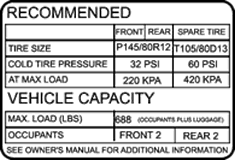
This is one I'm pretty good on. (Unlike #2, avoiding speeding...) Nevertheless, I'm continually surprised, to see how many people are driving around on tires that are so underinflated they're not only inefficient, but dangerous! The federal efficiency website again estimates that driving on underinflated tires can lose you a little over 3% on your fuel efficiency--more if your tires are VERY underinflated. Keep in mind, that as temperatures drop, tire pressures do too. Since we're heading into winter, please check your tire pressure regularly.There should be a label that looks like this:
#6) Remove Excess Weight
Did you know that every 100lbs you carry in your car, on average, reduces your fuel efficiency by 1-2%? So, if you don't have to have it with you, then leave it at home! Even a 2% increase in efficiency is like saving $0.06 a gallon when gas hits $3.00 per gallon! A lot of people will drive out of their way to save $0.02, or $0.03 on gas, and here's a way to save a lot and not drive anywhere!#7) Use the Recommended Grade of Motor Oil
I don't even know what grade oil my car is supposed to use. In fact, I never really gave it a thought. But it turns out that using the wrong grade oil can have a noticeable impact on your fuel efficiency! Using 10W-30 motor oil, for example, in an engine designed to use 5W-30 hurts efficiency between 1-2%. You can quickly find what grade oil your car should use by looking in your owner's manual.#8) Avoid Excessive Engine Idling
The federal site says it best: "Idling gets 0 miles per gallon."In today's modern cars, letting a car "warm up" before driving, or waiting with the engine running while parked is just burning up money.
#9) Use Cruise Control
Hearkening back to #1, cruise control helps avoid excessive acceleration, and keeps your car at a constant speed. This helps the engine run more efficiently, and use less gas.#10) Use Overdrive Gears
A lot of people aren't familiar with what an overdrive gear is: it's just a gear in your car's transmission that lets the engine not have to work as hard at higher speeds. Not only does it save gas (a lot!) but it helps your car operate more smoothly, quietly, and reduces engine wear.As a bonus feature, check out this great website. (www.milwaukeegasprices.com) It shows the gas stations with the lowest and highest gas prices in the Milwaukee area in the last 48 hours. It's updated all the time, and has seemed to be pretty accurate. Since there looks like over a $0.30 difference in prices between the lowest and highest priced gas stations, this site could also save you a nice pile of money.
posted by Braeger Automotive Group @ 6:28 PM
0 comments


0 Comments:
Post a Comment
<< Home